
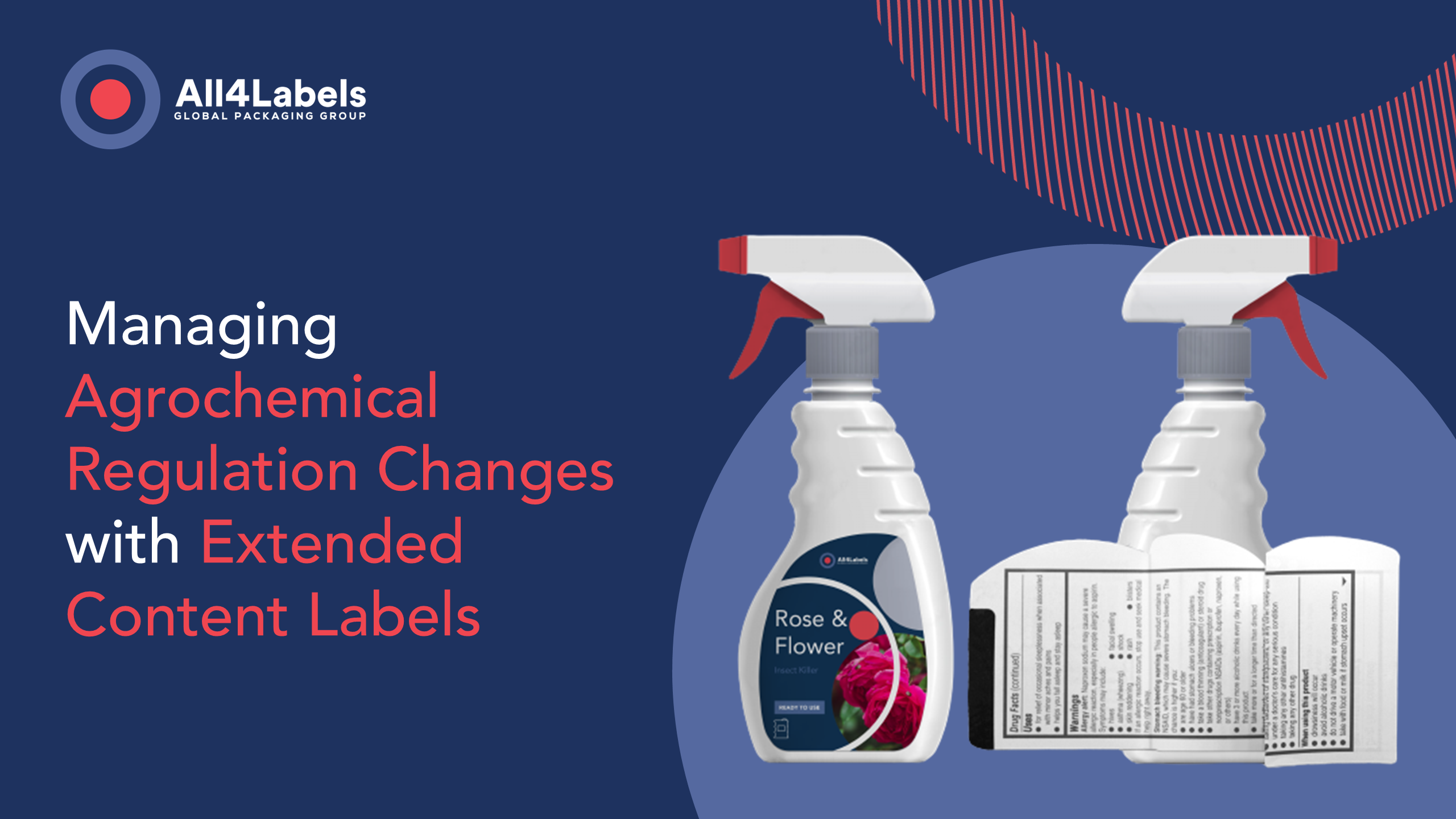
Within the agrochemical industry, compliance is continually changing. Regulatory information continues to grow, hazard classifications are updated, product instructions need to be clearer, and multilingual markets add further pressure to every label refresh.
These ever-changing regulations in turn have a huge effect on product packaging. Space becomes an issue – there often isn’t enough of it on a standard single ply label to hold all the required information!
This is where an efficient extended content label solution is required.
Extended content labels are flexible, adaptable options for brands who need to manage large amounts of legal copy, regulatory information and health and safety usages, without compromising shelf appeal.
For regulatory, packaging and marketing teams, they offer a practical route to producing CLP compliant labels that can keep pace with change.
What is Causing Growing Pressure in Agrochemical Product Labelling?
Agrochemical products carry a high compliance burden because labels must communicate critical safety information at the point of use. These include:
- Hazard pictograms
- Signal words
- Hazard statements
- Precautionary statements
- Directions of use
- Storage guidance
- Environmental protection instructions
- Batch information
- Contact details
- Disposal information
Where products are supplied across multiple territories, brands may also need multilingual compliance content that is accurate, legible and easy to navigate.
The challenge, simply put, is that your packaging sizes should be shrinking to reduce for sustainability, but the regulatory information required is expanding.
Traditional single-ply labels can quickly become overcrowded, forcing teams to reduce font sizes, compromise design hierarchy or use separate leaflets that not only complicate your supply chain but may also become detached from the container.
In a sector where misuse can have safety, environmental and legal consequences, a strong solution is required to tackle this challenge.
CLP Regulations: On-Pack Communication
CLP (classification, labelling and packaging) is a system used to classify chemical hazards and communicate them through standardised labelling elements. It’s important that these adopt to global standards to help protect health and the environment and provide emergency information. By law, any product containing hazardous ingredients must comply.
In the UK, GB CLP applies to manufacturers, importers, downstream users and distributors supplying the GB market, while Northern Ireland may be subject to EU CLP depending on the supply route.
For agrochemical brands, this means label artwork must be reviewed whenever classifications, formulations, claims, usage instructions or market requirements change.
Even small updates can trigger a cascade of amendments across product ranges, pack sizes and language variants. A slow artwork process can create compliance bottlenecks, delay launches and leave teams with obsolete printed stock. With modern consumers valuing environmental ethics, sustainability and needless wastage is something brands need to avoid.
How Extended Content Labels Solve the Space Problem
Extended content labels are designed to carry more information than a conventional label while keeping it attached to the product.
Instead of relying on a single visible face, they use extra printable layers to increase the available communication area. This makes them especially useful for chemicals, crop protection products, fertilisers and other regulated agrochemical packaging where detailed instructions and safety information must travel with the container.
Booklet Labels
One version of an extended content label is a booklet label. Booklet labels for chemicals are ideal when a product needs substantial instructions, multi-language text or detailed compliance content.
The top label houses your brand identity and essential hazard information, while the booklet pages provide additional room required for application rates, crop-specific instructions, first-aid guidance, storage requirements and regulatory statements.
Because the information remains fixed to the pack, it’s not only convenient for the consumer, but also legally compliant.
Peel and Read Labels
Peel and read or peel and reveal labels offer another efficient solution to additional space needs in agrochemical product labelling. These multi-layer labels can be peeled back to reveal additional content and then resealed, making them suitable for smaller packs, curved containers and products where the front-facing design needs to remain clean.
In the agrochemical packaging market, shelf appeal is still important. Information can be clearly displayed without an overwhelming amount of copy on the front of the label.
Multilingual Compliance Without Multiplying SKUs
An additional benefit of using extended content labels for your agrochemical product labels is the ability to optimise your packaging for selling into multiple markets.
Agrochemical products often move through complex distribution networks, and multilingual compliance can become a major packaging challenge.
Creating separate labels for every language or territory can increase stockholding, raise the risk of picking errors and make every regulatory change more expensive to manage.
Extended content formats help consolidate this information into one sort. A single booklet label can contain multiple language sections, each clearly separated and structured for quick reference. Peel-and-reveal labels can dedicate individual layers to different markets or instructions.
With careful artwork planning, icons, headings and layout systems can guide users to the right information while keeping mandatory content legible.
How Digital Print Supports Regulatory Agility
In heavily regulated markets, speed matters.
Digital print enables fast artwork updates due to faster set up times and eliminating the plate costs associated with traditional print methods, making it well suited to regulated sectors where content can change at short notice.
If a hazard statement changes, a new language version is required or a batch-specific detail must be added, digital label printing enables fast reactions.
Variable data printing adds another layer of control. It allows unique or changing information to be printed within the same production workflow, such as batch codes, product identifiers, regional details, barcodes, QR codes or sequential references.
For agrochemical brands managing many formulations and pack variants, variable data printing can reduce manual handling, improve version control and help ensure the right information appears on the right label.
Reducing Compliance Bottlenecks with Artwork and Reprographics Support
Agility in label production is not just about the print! It starts with clear, technically accurate artwork and a reprographics process that understands regulated labelling. Springfield, our dedicated packaging artwork management department can help agrochemical brands prepare labels that balance compliance, legibility, print performance and brand presentation.
That support can include:
- Setting up booklet and peel-and-reveal artwork correctly
- Managing small text and panel hierarchy
- Checking print-ready files
- Preparing multilingual layouts
- Handling version changes
- Ensuring variable data fields are production-ready
For packaging and regulatory teams, this reduces the back-and-forth that often slows down compliant label production.
Get in touch with the Springfield team to discuss your agrochemical packaging artwork!
A Smarter Label Strategy for Changing Regulations
The best time to plan for regulatory change is before the next update arrives.
Agrochemical brands that rely on rigid artwork processes and long print runs may find themselves exposed when classifications, instructions or market requirements shift.
At All4Labels, we provide an agile solution with extended content labels to create a more resilient model.