
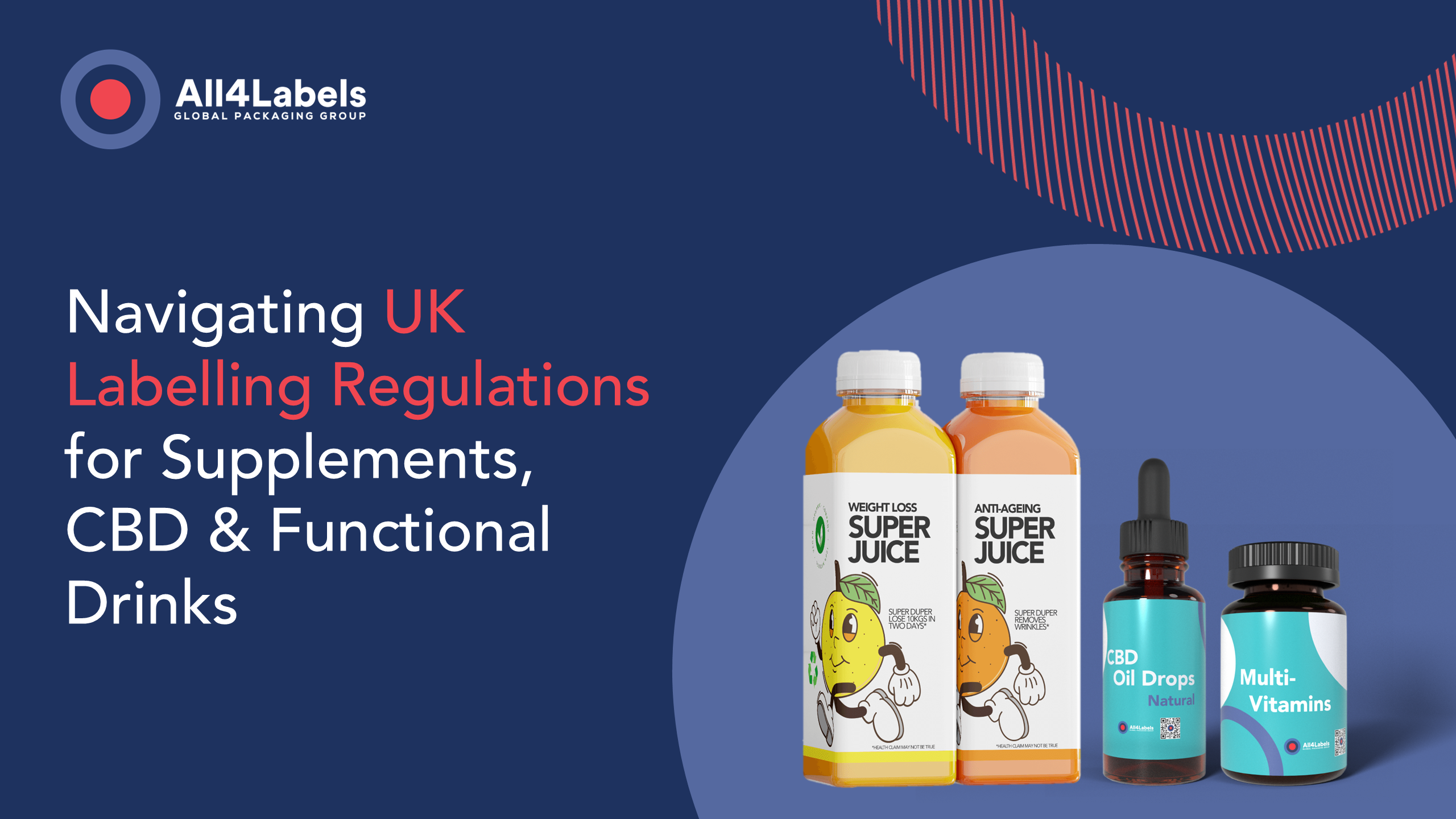
In the health and wellbeing market, compliance is of utmost importance when it comes to packaging and labelling.
For procurement teams and label buyers, understanding UK labelling regulations across supplements, CBD, and functional drinks is critical not only for legal market access but for consumer trust, retailer acceptance, and long-term scalability.
This helpful guide breaks down the key regulatory pillars shaping labelling in the UK. Discover how forward-thinking label strategies can turn compliance into a competitive advantage.
The Foundation: Nutrition & Supplement Labelling Requirements
All supplements and functional drinks sold in the UK must comply with overarching food labelling legislation, primarily retained EU Regulation (EU) No 1169/2011 (FIC), alongside the Food Supplements (England) Regulations 2003.
At a baseline, labels must clearly communicate:
- Product name and classification (must be labelled “food supplement”)
- Ingredients list and allergen information
- Net quantity
- Date marking (best before/use by)
- Nutrition declaration (where required)
- Business operator details
Beyond general food labelling, supplements carry additional mandatory statements, including:
- Recommended daily dose
- Warning not to exceed the stated dose
- Statement that supplements are not a substitute for a varied diet
- Storage instructions (e.g. keep out of reach of children)
For procurement teams, this means label and packaging space is already limited before marketing claims are even considered.
CBD Labelling: A Regulatory Grey Zone
CBD is one of the most scrutinised categories in UK labelling regulations today. Classified as a novel food, any ingestible CBD product must undergo authorisation before being legally sold to ensure public safety.
For brands already in-market, compliance hinges on alignment with guidance from the Food Standards Agency.
Key labelling considerations include:
- Clear indication of CBD content per serving
- Inclusion of safety warnings (e.g. not suitable for pregnant women, children)
- Advisory daily intake (currently 10mg for healthy adults)
- Avoidance of medicinal claims
Critically, CBD labels must also reflect evolving safety guidance. The FSA has actively encouraged businesses to update packaging as scientific advice develops, particularly around dosage and risk communication.
This creates a unique operational challenge: regulation is not static. Agility becomes essential to stay up to date with UK labelling regulations.
Digital print presents an agile solution for the labelling of CBD products, as regulations and research develops and evolves.
Unlike conventional printing methods, digital label production removes the need for printing plates, making artwork updates faster and more cost-effective. This is particularly valuable for CBD brands that may need to revise ingredient information, dosage guidance, or compliance messaging at short notice.
Combined with short lead times and the ability to produce smaller, versioned runs, digital print enables brands to stay compliant, reduce obsolete stock, and respond quickly to regulatory change without disrupting supply.
HFSS & the Shift Toward Health Positioning
HFSS (High Fat, Salt, Sugar) regulation is reshaping the broader food and drink landscape, especially in retail environments.
While supplements and functional drinks are often positioned as “better-for-you” alternatives, brands must be careful with product claims and ingredients.
- Products making health claims must substantiate them
- Functional ingredients must align with authorised claims frameworks
- Sugar content and formulation can impact classification and marketing permissions
The UK government’s push to reduce HFSS product visibility has indirectly accelerated growth in supplements, CBD, and functional beverages, but it has also increased scrutiny.
In practice, this means:
- Labels must avoid misleading “health halo” messaging
- Claims must be precise, evidence-based, and compliant
- Positioning must align with both nutrition and advertising standards
Traceability & Batch Coding
Traceability is a legal requirement and a critical risk management tool. For certain foods, the Food Safety and Hygiene (England) Regulations 2013 also enforces certain provisions around transportation and storage.
UK food law requires businesses to maintain records of:
- Suppliers and ingredient sources
- Production batches
- Distribution pathways
From a labelling perspective, this translates into:
- Batch or lot numbers
- Production codes
- Sometimes QR or digital traceability markers
Imported food must also comply with traceability regulations. For procurement and operations teams, this is where label design intersects with supply chain integrity. Poor batch coding can compromise recalls, audits, and retailer relationships, as well as increasing health and safety risks.
Extended Content Labels: Solving the Space Challenge
Modern health products are information-heavy:
- Regulatory statements
- Multi-ingredient breakdowns
- Usage instructions
- Warnings and disclaimers
- Sustainability messaging
Fitting all of this onto a single label, whilst maintaining brand impact, is a growing challenge.
This is where extended content labels (ECLs) such as peel and read labels, booklet labels and label on label constructions come into play.
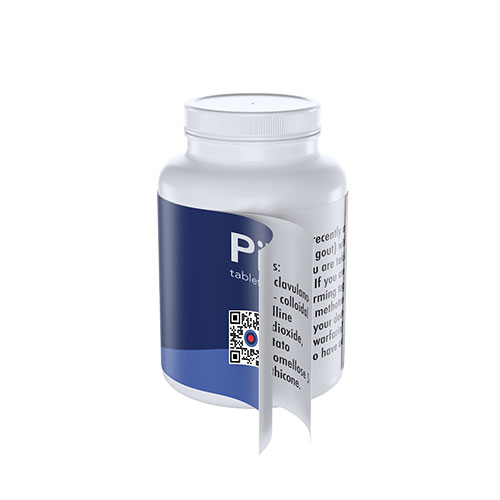
These solutions allow brands to remain compliant without sacrificing design or shelf appeal.
For CBD and supplements, where warnings and dosage guidance are extensive, ECLs are increasingly becoming a necessity rather than a premium add-on.
Speak to our team of experts about our extended content label solutions!
Multi-Language Requirements & Export Readiness
As UK brands scale into European and global markets, multilingual labelling becomes essential.
Challenges include:
- Different regulatory requirements per country
- Language variations for mandatory statements
- SKU proliferation
Digital print technology is transforming this space by enabling:
- Short-run, language-specific variants
- Rapid updates for regulatory changes
- Reduced waste compared to traditional print runs
Peel-and-read labels further enhance this capability, allowing multiple languages to coexist on a single pack, which is ideal for export or travel retail.
The Role of Digital Print & Smart Labelling Solutions
In a regulatory environment defined by change, especially in nutrition and supplements, speed and flexibility are strategic advantages.
Digital label production enables:
- Fast turnaround for regulatory updates
- Version control across SKUs
- No minimum order quantities
- Easier compliance testing before scaling with fast proofing
For example, when CBD dosage guidance shifted to 10mg/day, many brands were forced to relabel or reformulate quickly.
Those with an agile print partner are able to adapt their labels without major disruption. Our digital print site in Hull provides a maximum 5 day lead time upon approval of artwork, no MOQs and no plate costs. Providing a slick, efficient solution for brands in the health and wellness industry.
Compliance as a Growth Advantage
For established health and wellbeing brands, UK labelling regulations is a core part of product strategy.
To succeed in supplements, CBD, and functional drinks, brands must:
- Build compliance into product development from day one
- Design labels that accommodate both current and future requirements
- Partner with an agile print partner
- Maintain rigorous traceability systems
- Stay aligned with evolving guidance from regulators like the Food Standards Agency
How All4Labels Supports Compliance at Scale
Navigating this complexity requires more than just understanding the rules. It requires the right labelling infrastructure.
All4Labels supports brands who produce health and wellness products through:
- Digital print capabilities for rapid regulatory updates and short-run flexibility
- Peel-and-reveal labels to accommodate extended content without compromising design
- Multi-language solutions including peel-and-read formats for international markets
- Scalable production across digital, hybrid and flexo print methods aligned with procurement and supply chain demands
In a category defined by trust, transparency, and regulation, your label is your most visible compliance asset.
Brands that treat it as a strategic tool, not just a packaging component, will be best positioned to scale, innovate, and lead in the UK’s health and wellbeing sector.
Email sales.uk@all4labels.com to chat to our team about agile label supply for your products.