
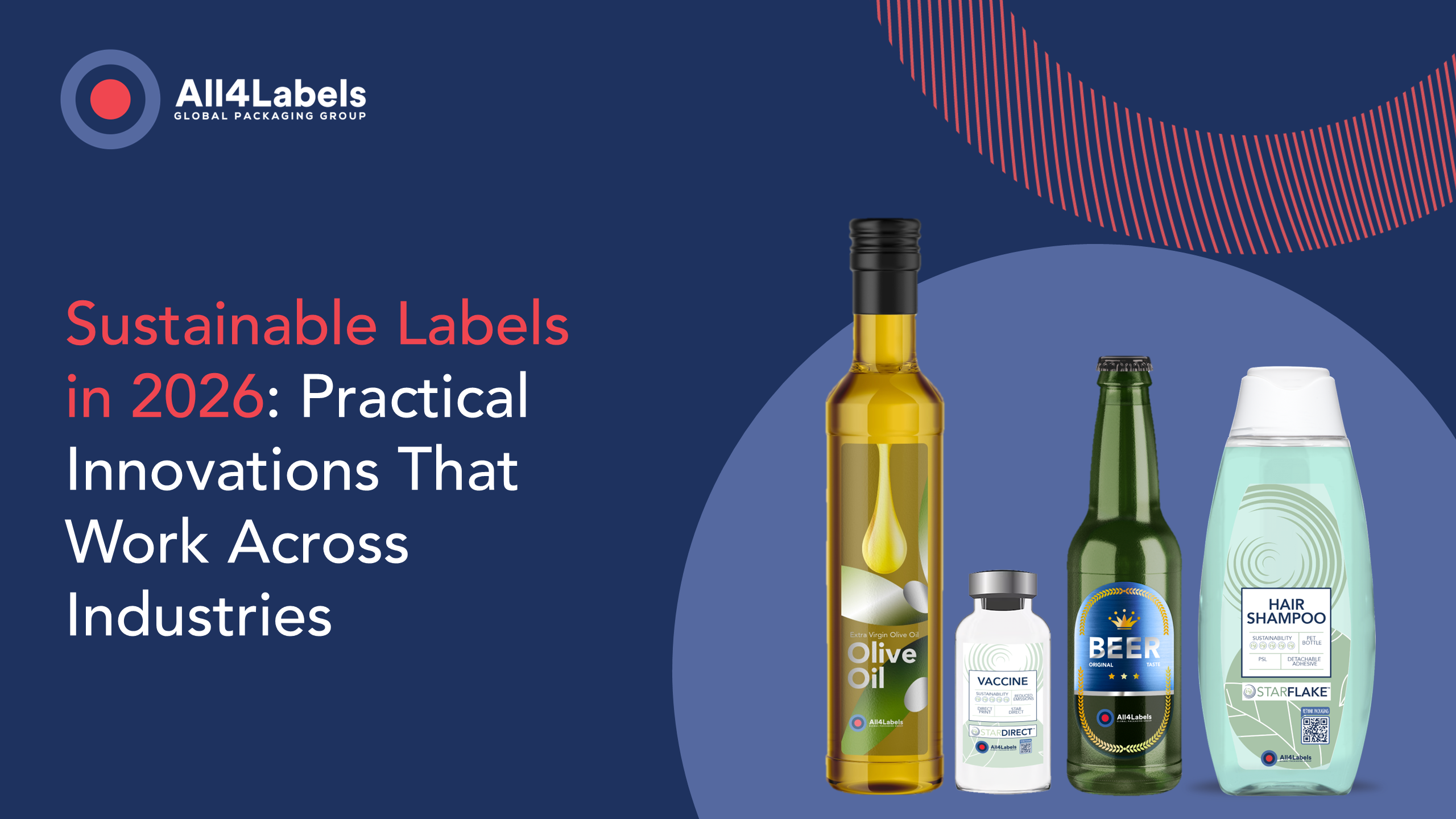
Sustainable labels are a present-day requirement. Across industries, procurement teams and buyers are under increasing pressure to deliver packaging that meets environmental targets, complies with evolving regulations, and remains commercially viable.
In 2026, sustainable labelling is not about bold claims or one-size-fits-all solutions. It’s about practical innovation – solutions that work on real production lines, across multiple sectors, and within the constraints of cost, performance, and compliance.
Here’s how the latest developments in sustainable labelling are helping brands move forward with confidence, and how All4Labels UK is leading the way.
Regulation is Reshaping the Packaging Landscape
For procurement professionals, regulation is one of the biggest drivers of change. In the UK and across Europe, policies such as the EU’s Packaging and Packaging Waste Regulation (PPWR) and the UK Plastic Packaging Tax (PPT) are fundamentally altering how packaging is designed, sourced, and evaluated.
The PPWR is pushing for:
- Increased recyclability of all packaging
- Reduced packaging waste
- Greater use of recycled content
Meanwhile, the UK’s Plastic Packaging Tax imposes financial penalties on packaging with less than 30% recycled plastic content, making material choices a direct cost consideration.
For buyers, this means sustainability is no longer just a brand value, it’s a procurement metric. Packaging decisions must now balance compliance, cost efficiency, and environmental impact.
This is where working with an experienced partner like All4Labels becomes critical. With deep regulatory understanding and a global innovation network, All4Labels helps businesses stay ahead of legislative change while maintaining operational efficiency.
Recycled Content Labels
One of the most immediate ways to improve packaging sustainability is through label materials made with recycled content.
Advancements in material science mean that labels can now incorporate post-consumer recycled (PCR) content without compromising on:
- Print quality
- Durability
- Adhesion performance
For procurement teams, this offers a straightforward route to improving sustainability credentials, whilst also contributing to compliance with recycled content targets under regulations like PPWR and PPT.
Importantly, these materials are now available across a wide range of applications, from rigid containers to flexible packaging, making them suitable for industries including beverages, home care, and health products.
Wash-Off Adhesives: Enabling True Recyclability
A label is only as sustainable as its end-of-life impact. Even if a bottle is fully recyclable, incompatible labels and adhesives can disrupt the recycling process.
Wash-off adhesives are a practical innovation that addresses this challenge. Designed to separate cleanly from containers during recycling, they:
- Prevent contamination of recycling streams
- Improve the quality of recycled materials
- Support closed-loop recycling systems
This is particularly important for PET bottles in the beverage industry, where label contamination can significantly reduce recycling quality.
For procurement teams, specifying wash-off adhesive systems is a simple but powerful step toward designing for recyclability, a key requirement under emerging regulations.
Lightweight Constructions: Reducing Plastic at Source
Reducing material usage is one of the most effective ways to lower environmental impact, and it’s an area where labels can make a meaningful contribution.
Lightweight label constructions use less material without sacrificing performance. This can include:
- Thinner facestocks
- Optimised adhesive layers
- Reduced liner weight
The benefits are clear:
- Lower raw material consumption
- Reduced transport emissions
- Potential cost savings
For high-volume industries like beverages and home & personal care, even small reductions in label weight can translate into significant environmental and financial gains.
All4Labels works closely with customers to identify opportunities for lightweighting, ensuring that sustainability improvements align with operational requirements.
Rethinking Decoration: STARSHINE™ Metallisation
Premium aesthetics and sustainability are often seen as competing priorities, but innovations like STARSHINE™ metallisation are changing that perception.
STARSHINE IMAGE
Traditional metallised labels including those with hot and cold foil applied to them can pose challenges for recyclability, particularly when they involve complex material structures. STARSHINE™ offers a more sustainable alternative by:
- Eliminating waste created by traditional metallisation methods
- Maintaining high visual impact and shelf appeal
- Designed to reduce CO₂ emissions by up to 80% compared to traditional metallic foils
For procurement teams, this means you don’t have to compromise on brand impact to meet sustainability goals.
Whether in beverages, personal care, or health products, STARSHINE™ enables premium decoration with a more responsible footprint, meaning you can start your packaging journey with sustainability at the forefront of design and manufacturing.
STARDIRECT™ “No-Label” Solution
STARDIRECT™, available in our Leeds site, is an exclusive and disruptive “no-label” solution that reduces material used.
This approach offers multiple benefits:
- Significant reduction in material usage
- Simplified recycling processes
- Clean, premium aesthetic
For procurement professionals, STARDIRECT™ represents a significant step in sustainability delivering both environmental and visual advantages.

Sustainability Across Industries
One of the key challenges in sustainable packaging is ensuring that solutions are scalable and adaptable across different sectors. The innovations outlined above are not niche, they are designed to work across a wide range of applications.
Food & Beverages
From wash-off adhesives to lightweight constructions and STARDIRECT™, food and beverage brands can significantly improve recyclability and reduce material usage while maintaining high-speed production efficiency.
Home & Personal Care
Premium aesthetics remain critical in this sector. Solutions like STARSHINE™ metallisation and recycled-content labels allow brands to balance shelf appeal with sustainability goals.
Chemicals
Durability and compliance are key. Advanced label materials with recycled content, combined with robust adhesive systems, ensure performance in demanding environments without compromising sustainability.
Health Products
Clarity, trust, and compliance are paramount. Sustainable label materials, combined with innovative constructions, support both regulatory requirements and consumer expectations.
Across all these sectors, the focus is the same: practical, proven solutions that deliver measurable impact.
From Innovation to Implementation
Sustainability in 2026 is not about experimentation, it’s about execution. Procurement teams need solutions that:
- Meet regulatory requirements
- Integrate seamlessly into existing operations
- Deliver cost-effective environmental improvements
All4Labels combines global innovation with local expertise to deliver exactly that. From material selection and adhesive systems to advanced decoration and label-free solutions, All4Labels provides a comprehensive portfolio designed to meet the needs of modern supply chains.
The Path Forward with All4Labels UK
As regulations tighten and consumer expectations continue to rise, sustainable labelling will remain a critical focus for businesses across all industries.
From recycled-content materials and wash-off adhesives to lightweight constructions, STARSHINE™ metallisation, and STARDIRECT™ no-label solutions, today’s innovations are not just theoretical, they are ready to deploy.
For procurement professionals, the opportunity is clear: by embracing practical, scalable solutions, you can turn sustainability from a challenge into a competitive advantage.
And with the right partner, that transition becomes achievable, efficient, measurable, and future-proof. Get in touch today by emailing sales.uk@all4labels.com.