
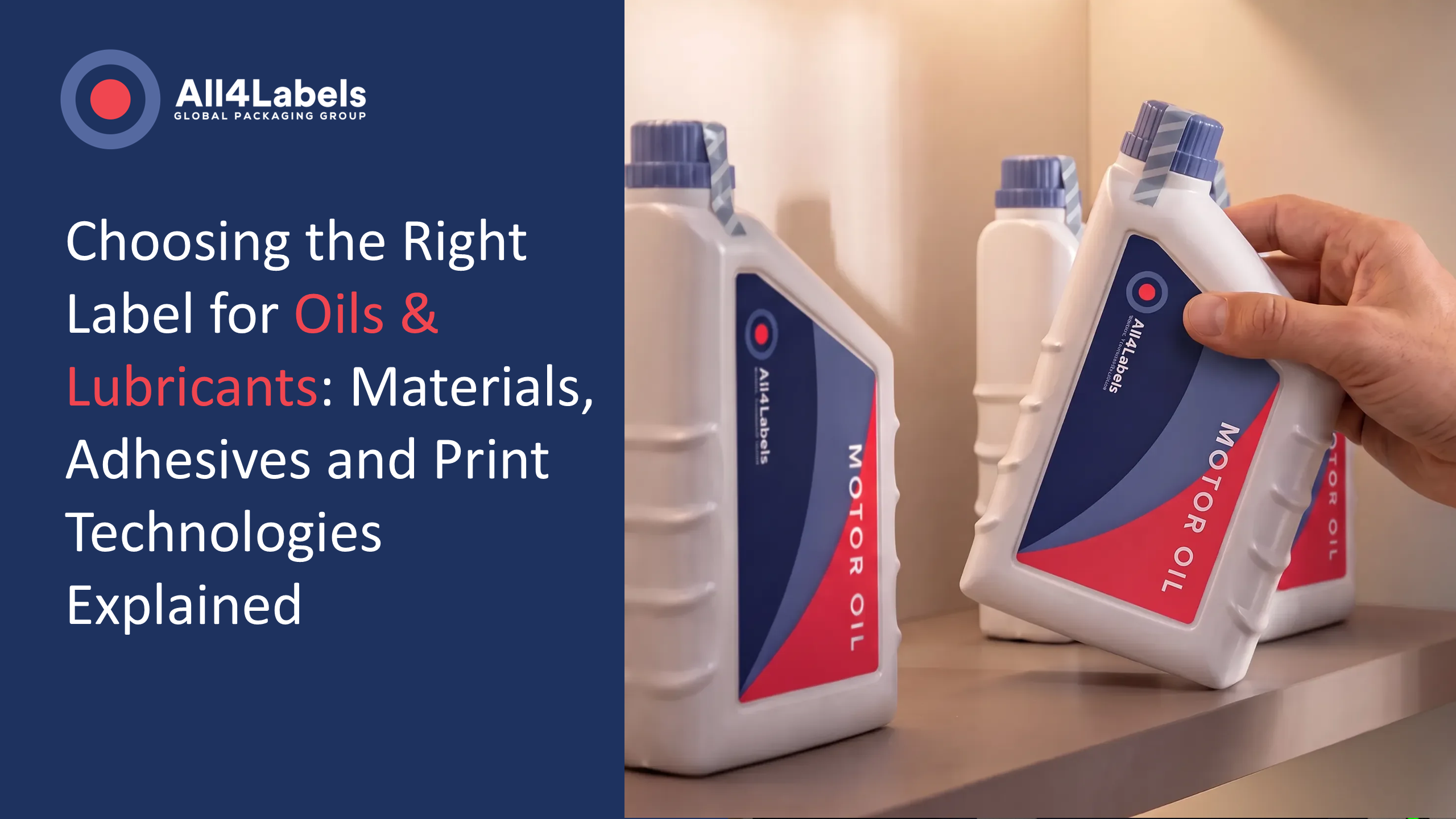
Specifying labels for oils & lubricants products can be a tougher job than many standard product labels. The labels must withstand oils, workshop environments, transport, storage and changing temperatures, whilst reliably communicating brand, safety and usage information.
For procurement and packaging teams, the best result comes from specifying the complete label construction: facestock, adhesive, print method and finish. If one element is wrong, the whole label can fail.
This practical guide explains the key decisions involved in choosing labels for lubricants, engine oils, greases, additives and wider automotive products. It also looks at how to balance performance, cost and sustainability without compromising the information your customers and supply chain rely on.
Why Choosing the Right Label Matters for Oils & Lubricants Brands
Oils and lubricants present unique challenges for product labelling. Exposure to oil, grease, chemicals, moisture, temperature fluctuations and regular handling can all affect label adhesion, legibility and overall performance.
Choosing the wrong materials, adhesive or print technology can lead to labels lifting, smudging, fading or becoming difficult to read. This can affect brand presentation, compromise the visibility of important product information and create avoidable costs through rework, product waste or relabelling.
The right label solution must withstand the conditions it will encounter throughout storage, transportation and use, while maintaining clear branding, product identification and essential technical information.
By understanding how label materials, adhesives and print technologies work together, oils and lubricants manufacturers can make informed packaging decisions that balance durability, print quality, cost efficiency and brand impact.
How to Match Label Materials and Adhesives to Your Product
Start with the container and environment
Before choosing a material or adhesive, define how the label will be used. A small engine oil bottle sold through retail has different requirements from an industrial drum stored outdoors in a harsh environment or a lubricant container used in a workshop.
Consider the container material, shape and surface energy, as well as whether the label will be applied to plastic, metal, glass, painted surfaces or flexible packs.
Also consider the full lifecycle. Labels may be exposed to oil during filling, abrasion in transit, moisture in warehouses, UV light outdoors and chemicals during use.
Different chemicals can attack labels in different ways, including dissolving inks, degrading adhesives or weakening facestocks.
A label that looks suitable on day one still needs to remain legible and attached when the product reaches the end user. The GHS (globally harmonised system) classifies and communicates hazardous properties of industrial and consumer chemicals and documents the mandatory label elements for chemical containers.
Choosing the right label material or facestock
The facestock is the top, most visible layer of packaging that displays branding, copy, barcodes and visuals.
For oils and lubricants, paper can be appropriate for lower-risk applications, short product lifecycles or secondary packaging. However, filmic materials are often the safer choice where durability is important. Polypropylene (PP), polyethylene (PE) and polyester (PET) are common options because they offer better resistance to moisture, tearing and handling than standard paper.
Polyethylene can be useful for squeezable or curved containers because it is malleable, helping the label follow the pack shape. PE film label materials are commonly recommended for oil cans and lubricant containers because they can be resistant to oil and lubricants, highly adhesive and conformable around shaped containers.
Polyester is often utilised where higher durability, heat resistance or chemical resistance is required. For premium retail oils, a clear or white film can support a high-quality shelf appearance while delivering the toughness needed for handling.
Adhesive selection matters as much as the material
Adhesive choice is one of the most common causes of label failure.
The adhesive must bond to the container at the point of application and continue to perform when exposed to the product, filling process and operating environment.
Key questions to consider include:
- Is the surface smooth or textured?
- Is the application area flat or curved?
- Will the container remain clean or is there a chance it could become contaminated?
- Is the container rigid or squeezable?
Permanent adhesives are normally used for lubricant labels and chemical resistant labels where removal would create safety, traceability or branding issues.
High-tack adhesives may be needed for textured containers, low-energy plastics or surfaces that are difficult to bond to.
In some cases, a specialist adhesive is required to cope with cold application, hot filling, moisture or exposure to oils and solvents. The best approach is to test the complete label on the actual container, using real application and storage conditions.
Check out our different types of labels for challenging environments.
Resistance requirements: oil, grease, chemicals, moisture and temperature
For labels for lubricants, resistance should be specified in practical terms rather than broad claims.
“Oil resistant labels” may need to withstand brief splashes, repeated oily handling or direct contact with product residue.
Chemical resistant labels may also need to tolerate fuels, cleaning agents, brake fluid, solvents or workshop chemicals.
Specialist chemical resistant labels can be produced to withstand substances such as fuel, brake fluid, white spirit, acetone, xylene, ethanol and IPA (isopropyl alcohol), but the exact requirement should always be confirmed against the intended exposure.
Moisture and temperature are equally important.
Products may sit in vans, warehouses, workshops or outdoor environments. Labels might face condensation, water spray, UV light, freezing conditions or elevated heat near engines and machinery. Some heavy-duty industrial label materials are designed for waterproof, oil-resistant and extreme-temperature performance.
If a product is regulated, exported or used in hazardous environments, ensure the label construction supports any relevant compliance requirements and remains readable throughout use.
Choosing the Right Print Technology for Performance, Quality and Supply Chain Efficiency
The right print technology depends on run length, artwork complexity, versioning, lead time and finish.
Digital Label Printing for Oils & Lubricants Products
Digital printing is often ideal for short to medium runs, multiple SKUs, seasonal promotions and fast changing product lines.
Without the need for printing plates, digital label printing can be more efficient for product lines with many variants, small quantities or frequent artwork updates.
It can also deliver high-quality colour reproduction and variable data, including batch details, QR codes or multilingual information.
For oils and lubricants brands, digital label printing helps manage SKU complexity while maintaining consistent branding across diverse product ranges.
Flexo Label Printing for Oils & Lubricants Products
Flexographic printing is well suited to longer production runs where consistency, efficiency and repeatability are priority.
Once printing plates are produced, the flexo printing method can be efficient for large quantities of oil bottle labels, lubricant labels and automotive product packaging.
It supports consistent colour reproduction across repeat orders and offers a broad choice of label materials, inks and finishes.
For established products with predictable demand, flexo provides a reliable way to maintain brand consistency. As well as meeting production volumes and performance requirements.
Hybrid Label Printing for Oils & Lubricants Products
Hybrid printing combines the flexibility of digital technology with the efficiency and finishing capabilities of flexographic printing. This makes it particularly useful for oils and lubricants brands managing complex product ranges that require both high-quality graphics and functional information.
Hybrid presses can combine digital imagery and variable data with flexo-applied colours, coatings and finishes in a single production process.
This allows brands to balance detailed designs, consistent colour reproduction and practical embellishments while accommodating multiple SKUs. By combining technologies, manufacturers can achieve greater production flexibility without compromising label quality or shelf impact.
Many brands are combining digital and conventional printing technologies to achieve the best results.
Choosing Premium Label Finishes to Highlight Quality
Premium finishes can help oils, additives and automotive products stand out, particularly in retail and e-commerce.
Matt or gloss varnishes, laminates, metallic effects, textured finishes and high-build varnish can all support brand positioning.
They can also provide a functional benefit. A laminate or protective varnish may improve scuff resistance, moisture resistance and print durability, which is valuable for products handled in oily or abrasive environments.
The key is to use premium finishes where they add value. A high-end motorsport lubricant may justify a tactile finish or metallic detail. While an industrial grease supplied in bulk may need a simpler, robust label focused on legibility and compliance.
For procurement teams, the decision should be based on brand value, sales channel, durability requirements and total applied cost.
Sustainability Considerations When Specifying Oils & Lubricants Labels
Sustainability should be built into label specification from the outset. Balancing environmental impact with the durability and performance required for oils and lubricants products. Considerations may include lightweight label materials, reduced material usage, recyclable-compatible facestocks, and options that support the recycling of the overall packaging.
Production efficiency also plays a role in sustainability.
Optimising print runs, reducing setup waste and ordering quantities that reflect actual demand can help minimise material waste and excess stock. Digital printing can be particularly useful for managing multiple SKUs and frequent artwork changes. Reducing the risk of obsolete labels when product ranges or regulatory requirements evolve.
The right specification will depend on the container, product application and end-of-life requirements. Working with a label supplier to assess material compatibility, durability and recyclability can help brands make informed choices. All without compromising product information, compliance or label performance.
Achieve the Best Label Specification for Your Oils & Lubricants Products
Choosing the right label means balancing durability, print quality, brand impact and sustainability. By considering your container, operating environment and production requirements from the outset, you can specify a solution that protects essential product information and performs throughout the supply chain.
At All4Labels UK, we work with brands to deliver label solutions tailored to their products. Combining digital, flexographic and hybrid printing capabilities with a range of materials and finishes.
Looking to review your current oils & lubricants label materials specification or develop a solution for a new product? Contact our team to discuss your oils and lubricants labelling requirements.