
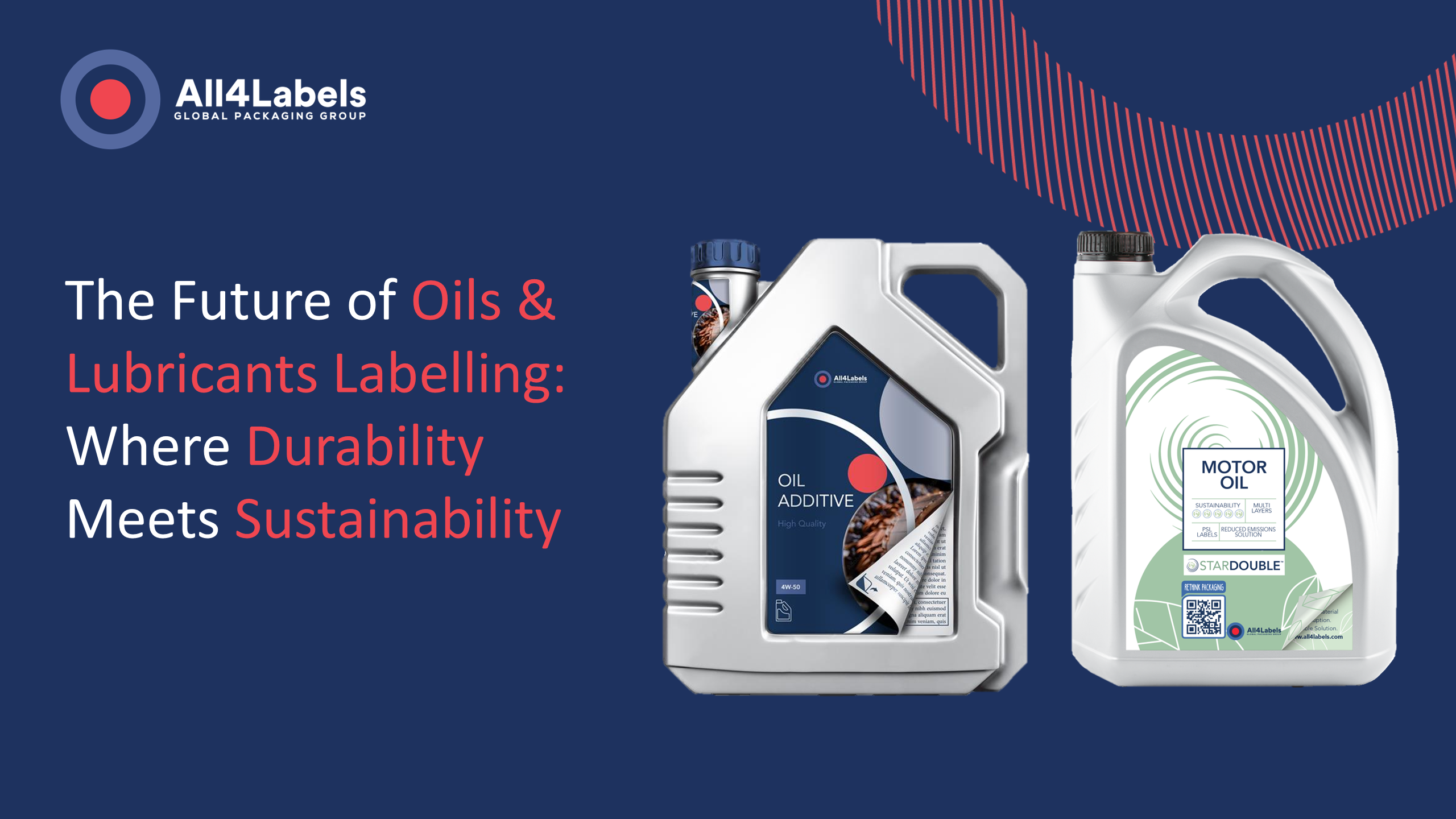
The oils and lubricants market, spanning automotive, industrial, and engineering applications, operates in some of the harshest packaging conditions imaginable. From exposure to aggressive chemicals and fluctuating temperatures to abrasion, moisture, and long storage cycles, product labels in this sector are required to perform far beyond basic identification.
At the same time, increasing regulatory pressure and sustainability expectations are reshaping how brands approach labelling and packaging.
As we look to the future of oils and lubricants labelling, one thing is clear: success lies at the intersection of durability, compliance, supply continuity, and sustainable innovation.
Labels are no longer just functional components. They are critical brand assets that must endure extreme environments while supporting broader environmental goals.
Understanding Label Requirements in the Oils & Lubricants Sector
Labels for oils and lubricants face a unique combination of technical and regulatory demands.
Products are often handled repeatedly, stored for long periods, and exposed to substances such as mineral oils, synthetic lubricants, fuels, solvents, and cleaning chemicals. Any label failure (smudging, peeling, fading, or tearing) can lead to compliance issues, safety risks, and brand damage.
Key performance requirements typically include:
- Chemical resistance to oils, greases, fuels, and additives
- Strong adhesion to challenging surfaces such as plastic containers, metal drums, and coated substrates
- Durability under abrasion, temperature variation, UV exposure, and moisture
- Legibility and permanence of mandatory information over the product’s lifecycle
- Compliance with regional and international regulations, including GHS/CLP, REACH (Europa, 2025), and transport standards. (FOSFA, 2015)
In industrial and automotive environments, labels must remain intact and readable from production through transport, storage, and end use, which can sometimes be over several years.
Market Trends Shaping Oils & Lubricants Labelling
The oils and lubricants market is evolving rapidly, and labelling solutions must evolve at a concurrent pace. So, what industry challenges must you consider when purchasing labels, and what are the solutions that match these challenges?
1. Extended Content and Regulatory Complexity
Regulatory requirements are becoming more detailed, driving the need for extended content labels.
Multilingual information, hazard pictograms, safety instructions, and traceability data must all fit onto limited packaging space without compromising clarity or durability.
This has increased demand for multi-layer labels, peel-and-read solutions, and highly durable print technologies.
In the UK, chemical labelling and packaging must comply with the GB CLP Regulation, which places clear duties on manufacturers, importers and downstream users to classify, label and package hazardous substances and mixtures appropriately before they are placed on the market. These requirements — including hazard pictograms, signal words and safety information — are not optional and must be presented clearly on packaging to meet legal obligations. (HSE)
Extended content formats such as multi-page booklet labels or peel-and-read solutions allow brands to include all mandatory regulatory information, including hazard and precautionary statements, without sacrificing legibility or pack aesthetics.
2. Sustainability Without Compromise
Sustainability is no longer optional. Brands across all sectors, including the Oils & Lubricants sector, are seeking labelling solutions that reduce environmental impact while maintaining high performance. This includes:
- Reduced material usage
- Recyclable or recycled content
- Compatibility with recycling streams
- Responsible sourcing and production practices
The challenge lies in achieving sustainability without sacrificing chemical resistance or adhesion, especially for products exposed to aggressive substances.
Read more about the sustainable packaging innovations available from All4Labels UK.
3. Premium Branding in a Technical Market
Even in industrial sectors, branding matters.
Oils and lubricants brands increasingly use visual differentiation to communicate quality, performance, and reliability.
In labelling, this can include metallic effects, high-gloss finishes, and tactile elements.
These luxury labelling features are becoming more common, particularly in the premium consumer automotive ranges. Your product packaging must now combine aesthetics with demonstrable durability to stand out!
4. Supply Continuity and Global Consistency
With global supply chains under pressure, manufacturers need partners who can ensure consistent quality and reliable supply across regions.
Standardised label materials, scalable production, and local manufacturing capabilities are becoming essential to reduce risk and maintain continuity.
At All4Labels, not only do we have an agile supply chain across our UK sites, but we also have access to a Global network of 50 label and packaging production sites across the Globe. Check out our Global locations here.
Engineering Durability: Chemical Resistance and Adhesion
Ultimately, what lies at the heart of oils and lubricants labelling is performance under pressure.
Your product labels must withstand continuous contact with oils, greases, and chemicals without degrading.
At All4Labels, we address this challenge through carefully engineered material and adhesive combinations designed specifically for harsh industrial environments. By helping you select face materials and coatings that resist chemical attack, plus pairing them with adhesives developed for difficult substrates, your labels remain securely in place and visually intact throughout the product lifecycle.
Adhesion is particularly critical for containers made from HDPE, PP, metal, or coated surfaces, common formats in oils and lubricants packaging. Advanced adhesive technologies ensure strong bonding supporting long-term durability and compliance.
Choosing the right label adhesive, particularly when extreme durability is required, is key. All4Labels are here to guide your brand to the right choice.
STAR Portfolio: Performance-Driven and Sustainable
To meet the evolving demands of the oils and lubricants market, we offer a range of sustainable packaging solutions. Our STAR portfolio is designed to combine durability, regulatory compliance, and sustainability.
By balancing performance with sustainability and durability, the STAR portfolio enables brands to future-proof their labelling strategies without compromising on reliability.
STARSHINE™: Metallic Impact with Industrial Strength
For brands looking to elevate shelf presence while remaining considerate of the environment, STARSHINE™ delivers a distinctive solution. Designed to create striking metal-effect finishes as an alternative to traditional foiling methods, STARSHINE™ provides premium visual impact, ideal for automotive oils and specialty lubricants.
Sustainability in Industrial Labels: A Practical Approach
Sustainability in the oils and lubricants sector must be realistic, and application driven.
Unlike fast-moving consumer goods, industrial labels cannot compromise on durability or safety. The future lies in incremental, intelligent improvements, including lighter constructions, recyclable materials where possible, and reduced waste across the supply chain.
Industry research highlights that, across sectors in 2025, companies are increasingly prioritising material innovation and circularity as central components of sustainability strategies. This includes moving away from virgin plastics toward renewable and recycled substrates, designing packaging for recyclability or reuse, and simplifying material compositions to improve end-of-life processing. These efforts are being driven by both regulatory changes and consumer expectations, with sustainability evolving from a marketing claim to a measurable performance metric. (Packnode, 2025)
All4Labels works collaboratively with customers to assess sustainability opportunities that align with real-world usage conditions. By considering the full lifecycle of the label and packaging, brands can make measurable progress toward environmental goals while maintaining operational excellence and the all-important consumer experience.
Looking Ahead
The future of oils and lubricants labelling is defined by balance: durability with sustainability, compliance with creativity, and performance with premium branding.
As expectations from consumers continue to rise, labels will play an increasingly strategic role in protecting products, supporting regulation, and differentiating brands.
By combining expertise in labelling technologies and a strong commitment to sustainability, All4Labels helps oils and lubricants manufacturers meet today’s challenges, and prepare for tomorrow’s demands.
Get in touch to future-proof your brand through durable packaging solutions.