
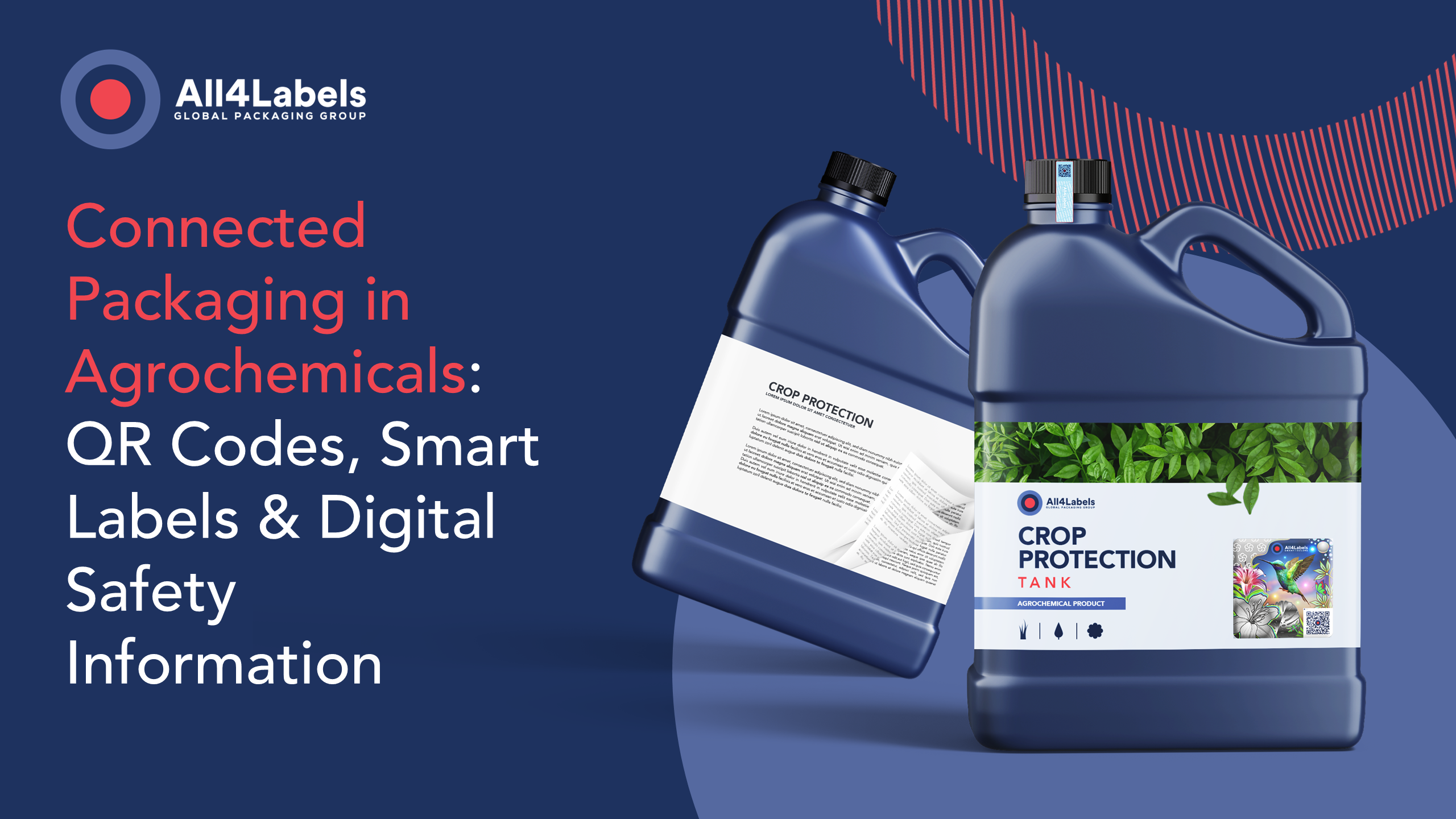
Connected packaging can make a tangible, measurable difference to agrochemical brands facing the stringent demands of the market.
By combining printed labels with digital connections – including QR codes that can house easily accessible online safety content and regulation information – agrochemical brands can turn every pack into a gateway to safe product use.
Connected packaging solutions offer a practical way to simplify compliance, improve safety communication and strengthen traceability without overloading the physical label.
Requirements of Agrochemical Packaging
Labels for agrochemicals need to communicate a wide range of essential information for both regulatory compliance and customer safety, this can include:
- Hazard pictograms
- Signal words
- Precautionary statements
- Directions for use
- Dilution instructions
- Environmental warnings
- First aid guidance
- Storage advice
- Disposal information
- Batch/serial data
Exporters may also need to present this information in multiple languages. Which puts extra pressure on your labels.
Connected Labelling Solutions
To tackle these demanding requirements of your label, there is a lot to consider – and often brands are at battle with aesthetics vs compliance!
One solution to this is to integrate digital connectivity into your labels. Ticking both boxes when it comes to keeping your customers informed and safe, while still maintaining visual aesthetics.
QR Codes to Reduce On-Pack Clutter
QR codes are one solution to smart labels for your agrochemical products. These provide a simple and familiar way to connect physical packaging with digital content.
A small, printed code can direct users to several types of content such as:
- Product pages
- Safety data sheets
- Instructions for use
- Emergency guidance
- Distributor resources
This is particularly valuable where container space is limited. As well as when a product requires extensive supporting documentation that simply cannot fit on the packaging.
For agrochemical brands, the benefit of using QR codes on your label is not just space saving.
QR codes can help create a cleaner and more readable label. This is achieved by moving non-essential supporting content into a digital environment. That means the printed pack can focus on the information that must be visible immediately. While the digital experience can carry expanded guidance, videos, translations, handling instructions and technical documents.
NFC-Enabled Labels for Agrochemical Products
NFC (Near-Field Communication) technology uses short-range wireless communication to enable data to be exchanged between an NFC-enabled label and a compatible smartphone or device. For agrochemical brands, integrating NFC technology into product labels can create a simple, contactless way to connect physical packaging with digital information.
With a tap of a smartphone, users can access a range of digital content linked to the individual product. This could include product information, application guidance, safety documentation, technical data, authenticity checks or other resources that support the safe and effective use of agrochemical products.
NFC-enabled labels can also help brands strengthen product traceability and authentication. Providing an additional layer of confidence across complex agricultural supply chains. As product information and regulatory requirements evolve, digital content can also be updated without requiring the physical label to be redesigned and reprinted.
Through INTEGRITAG, All4Labels can integrate NFC technology into labels. Helping agrochemical brands combine high-quality physical packaging with connected digital experiences that improve access to information, traceability and product security.
RFID-Integrated Labels for Agrochemical Products
RFID (Radio Frequency Identification) integrated labels take connected packaging a step further. Enabling agrochemical products to be identified, tracked and monitored without requiring direct line-of-sight scanning.
This can provide valuable benefits across complex agricultural supply chains. From manufacturing and distribution through to storage and use.
Each RFID label contains a unique electronic identifier that can be read remotely. Therefore, allowing businesses to improve visibility of product movements and strengthen inventory control. For agrochemical manufacturers managing multiple products, batches and distribution channels, this can support more efficient stock management and traceability.
RFID technology can also play an important role in product authentication. With agrochemical products moving through global supply chains, integrated RFID labels can help brands verify products, identify potential discrepancies and provide greater confidence in product provenance.
Beyond supply chain management, RFID-enabled packaging can complement wider connected packaging strategies by linking physical products to digital information. This could include:
- Product identification
- Safety information
- Technical documentation
Ultimately, resulting in a more connected experience for distributors and end users.
Through INTEGRITAG, All4Labels delivers intelligent label solutions that integrate RFID technology with high-quality label production. For agrochemical brands, this creates opportunities to combine robust, functional packaging with digital connectivity. Resulting in greater traceability, efficiency and product security.
Why You Should Integrate Connected Packaging in Your Agrochemical Products
Smart Packaging Improves Access to Safety Information
The use of connected packaging in agrochemicals can support safer product use by making safety information available at the point of need.
A farmer, agronomist, warehouse operator or transport partner can scan the code on the pack and instantly access relevant guidance on a phone or tablet. This may include:
- Updated safe handling information
- Spill response instructions
- Transport notes
- Product compatibility guidance
- Links to the latest documentation
Digital safety information packaging is especially useful when documentation needs to stay current.
Printed labels are fixed once produced. Whereas digital content can be reviewed and updated more efficiently. This helps reduce the risk of outdated supporting information circulating in the supply chain. As well as giving manufacturers a clearer process for maintaining document governance.
Multilingual and Accessible Information on Agrochemical Labels
Connected packaging can also improve communication in industrial and chemical applications where literacy, language or accessibility needs vary.
For example, a scan of a QR code or NFC tag could open a page with product instructions in multiple languages, audio-supported guidance, diagrams or short instructional videos.
Accessibility is an increasingly important feature in packaging, and interactive labels help brands facilitate better communication for all audiences.
For agrochemical products used across different regions and working environments, this flexibility can help brands communicate safety information more clearly and consistently.
Strengthening Traceability Across the Agrochemical Supply Chain
Connected packaging can give agrochemical manufacturers greater visibility over products as they move through the supply chain.
A QR code, NFC tag or RFID-enabled label can link an individual product, batch or SKU to digital records, helping manufacturers and supply chain partners access information about its origin, movement and status. This can support more efficient inventory management and make it easier to identify products or batches when required.
For products moving through multiple stages of manufacturing, distribution, storage and application, connected labels can provide an additional layer of traceability. They can also support product authentication, helping brands and customers identify potentially unauthorised or counterfeit products.
As agrochemical supply chains become increasingly complex, connected packaging provides a practical way to connect the physical product with the digital information surrounding it.
All4Labels Solution to Connected Packaging in Agrochemicals
Variable Data Printing Supports Product-Level Traceability
Variable data printing is a key enabler of connected packaging in agrochemicals. Allowing information to be changed from one label to the next within the same print run.
Rather than printing identical labels across a full production run, unique or batch-specific information can be incorporated into each label. This can include serial numbers, batch and lot codes, production dates, product references and other variable information required for identification and traceability.
For agrochemical manufacturers, this creates opportunities to connect the physical product with digital information. Unique QR codes, for example, can be printed directly onto labels and linked to specific products, batches or digital records. When scanned, the code can take users to relevant product information, technical documentation, application guidance, safety information or other digital content.
This approach can be particularly valuable for manufacturers managing large numbers of SKUs, product variants and batches across different markets. Unique identifiers provide greater visibility over products as they move through manufacturing, warehousing and distribution, while digital connections can make supporting information easier to access at the point of need.
Digital Print for Flexible, Data-Rich Agrochemical Labels
All4Labels’ digital printing capabilities make it possible to produce labels containing variable information without the need for traditional plates for every change.
This can provide greater flexibility for agrochemical manufacturers. Including managing multiple SKUs, smaller batches, market-specific versions or frequent artwork and data changes.
Variable data can be incorporated as part of the wider label production process, helping brands move towards more connected packaging while maintaining the print quality, consistency and functional performance expected from agrochemical labels.
Through INTEGRITAG, All4Labels combines smart label technologies with its wider label production capabilities. Thus, helping agrochemical brands connect individual products to the digital information, traceability and authentication systems that support them throughout the supply chain.
The Future of Connected Packaging in Agrochemicals
Connected packaging in the UK is moving from novelty to infrastructure. In agrochemicals, its value lies in making complex information easier to manage and easier to use. QR codes, smart labels, digital safety data sheets, interactive labels, variable data printing and traceability solutions can all work together to create packaging that is clearer, more responsive and more accountable.
For compliance-driven and innovation-focused businesses, the opportunity is significant. Smart agrochemical packaging can reduce on-pack clutter. As well as improve access to safety information, support multilingual communication and provide stronger traceability across the supply chain.
Most importantly, it helps packaging do what agrochemical packaging has always needed to do. Protect users, support responsible handling and keep essential information connected to the product wherever it goes.
To chat more about connected packaging in agrochemicals and to see how interactive chemical labels can work for your brand, get in touch with our team!